Thursday, May 16, 2013

Passamaquoddy Traditions

To help us learn about Maine Native Americans, Mr. Colson (who teaches middle school) came to our class today.  Mr. Colson is part Passamaquoddy.  He shared with us some Passamaquoddy words, showed us a basket made from sweetgrass by a master basket maker, and let us see a decorative piece (that would be worn like a tie) made from elaborate beadwork.  With the help of seventh graders Amber and Alayna, Mr. Colson also treated us to fry bread - a traditional Native American food.

Many were interested in the recipe for fry bread.  This is how Mr. Colson made it:

2 cups flour
2 teaspoons baking powder
a little sugar
a little salt
and just enough milk or water to make it "sticky" (not as thin as pancake batter)

Amber and Alayna used an electric griddle to fry the dough, but you can also use a deep fryer.
Mr. Colson says that you must use real butter on the fry bread when you eat it (not margarine!).

Mr. Colson also told us that a Passamaquoddy tradition when eating is that the oldest is served first.  So we lined up in order of age and followed the tradition!

"Woliwon", Mr. Colson, Amber, and Alayna - Thank you!


Dates to Know

Here is an on-line copy of the paper that was sent home the other day:

Tuesday, May 21:  Second Grade Field Trip to Abbe Museum
Friday, May 24:  No School - Teacher Inservice
Monday, May 27:  No School - Memorial Day
Friday, May 31:  1:00 K-4 Spring Concert
Thursday, June 6:  1st and 2nd grade field trip to Moose Point State Park
                             (More information and sign-up to chaperone will come home later.)
Tuesday, June 11:  Field Day
Thursday, June 13:  Last Day of School


** Another reminder that if you would like to chaperone any field trips, help out at Field Day, or volunteer in any way -- you must complete the paperwork, background check, and Volunteer Training through the office.

Tuesday, May 7, 2013

Save the Date!

The Second Grade Field Trip to Abbe Museum in Bar Harbor is *tentatively* scheduled for Tuesday, May 21.  We are on the calendar at the museum, and are just waiting to hear approval from the school and bus company.  Remember, this is not yet a guarantee.  But if we get approved, the date is set.

The Abbe Museum is dedicated to educating those of all ages about Maine Native Americans.  Mrs. Lent and I like to attend a program that is geared toward second grade; which includes traditional story telling, a tour of artifacts, and a Native American inspired craft.  

Friday, May 3, 2013

Parent Volunteers, Field Day, and Field Trips

It's that time of the year when classrooms are starting to schedule field trips and Field Day.  Our school has a new policy this year that states that all parents who wish to volunteer in any way during a school function must go through FERPA training and a background check.  Many parents in our classroom are already greatly involved and are all set to finish out the year.  Some of you, however, may be thinking about helping out during some of our end-of-year activities, and are volunteering for the first time.  Please be sure to contact the office as soon as you can if you are not already on our "Approved Volunteer List".

Here is what I know so far for dates:

Field Day:  Tuesday, June 11

Field Trip to Moose Point State Park (1st and 2nd grade):  TENTATIVE DATE Thursday, June 6 (**This is not yet cleared by the office and bus company.**)

Field Trip to Abbe Museum:  (2nd grade)  I am waiting to hear back from the director of educational services at Abbe Museum.  I offered several possible dates, so I cannot begin to guess when this will be (or even if we can make our schedule work with the museum's schedule; or if it will get approved)

M&Ms and Reading Activities

To wrap up our unit on fractions, parent volunteer Jen Ramos led the class in an M&M fraction activity.  Students were to estimate totals, find fractions of a group, compare fractions, sort and regroup to find new fractions, and eat M&Ms (that was the challenging part!).  Thank you, Mrs. Ramos for the delicious math lesson!


Mrs. Ramos and baby Isabella.

Although reading is woven throughout our day through a variety of areas, our Reading Block is a time when students are found in small groups doing a variety of activities.  Here are some pictures to show some of what we are up to:
Buddy Reading


Literature Circle Discussion


Independent Reading

Written response to reading.  Gavin and Isabelle are applying
their learning about generalizations and supporting details,
while following directions on a reading activity card.
Also at that time, small groups of readers meet with me for guided reading instruction, students participate in various word work activities (including learning spelling rules, dictionary work, ABC order, etc.), and students continue to add to their poetry books.  There is such a variety of ways for students in second grade to become engaged in literacy activities!

Thursday, April 4, 2013

Fraction Fun and Other News...

We have spent the last few weeks exploring fractions.  Students are learning to identify halves, thirds, and quarters of an area or object, as well as halves, thirds, and quarters of a set.  Students have also learned the terms for a fraction (such as "one half" or "one third") and the notation for the fraction (like 1/2 and 1/3 - except we have been writing them with the numbers stacked and the fraction bar horizontal, not diagonal).  We are using vocabulary such as "numerator" (the number on top of the fraction) and "denominator" (the number on the bottom of the fraction); and understand that fractions are equal parts of an object or group.  Students have also been exploring equivalent fractions (fractions that are equal, such as 1/2 = 2/4), fractions that show more than one part (3/4, 2/3), and mixed numbers (1 1/2, 2 3/4). 
Perhaps the most meaningful activity we did to work with fractions was working with Hershey bars!  Thank you to Mr. Dale for providing the class with edible fractions!

One Whole Hershey Bar

One Half

Another Way to Show One Half


Split Into Quarters, or Fourths

A Different Way to Split Into Quarters - each section is still equal!
More Quarters

One of these pieces is 1/6 of the Hershey bar.

Finding multiple ways to create quarters and thirds of the same area.

Fraction Flags

More Fraction Flags

Science and Social Studies are being integrated throughout our days.  We are finishing up research on weather; and are using our Biography unit to jump into learning about our government - focusing on some important contributions of Abraham Lincoln and George Washington, as well as our U.S. Constitution and the voting process. 

Although we have covered the needs of "Living Things" in various parts of the school year, we will also spend more time Fourth Quarter focusing on vertebrates, interdependency of plants and animals, similarities and differences. 

In Writing Workshop, we have been working hard on our Biographies.  Thank you to all those who supported us with our interviews!  These biographies will go through the editing process and end up as published pieces on display. 

Some dates to Remember:

April Book Orders will go home on Friday, April 5.  They will be due Thursday, April 11.  Please be sure to send a check or money order only - not cash.  Last month I ended up writing a check for almost $50 to cover all of the cash orders.  Ordering online is another option (go to scholastic.com; the activation code is FZY46).

NWEA testing for Spring will begin right after vacation.  Our class will test on Mondays, so our test dates are: Monday, April 22, April 29, and May 6.  Please make sure your child is well rested and has had a good breakfast and lunch for the day.

Sunday, March 3, 2013

Learning on a Sea of Talk

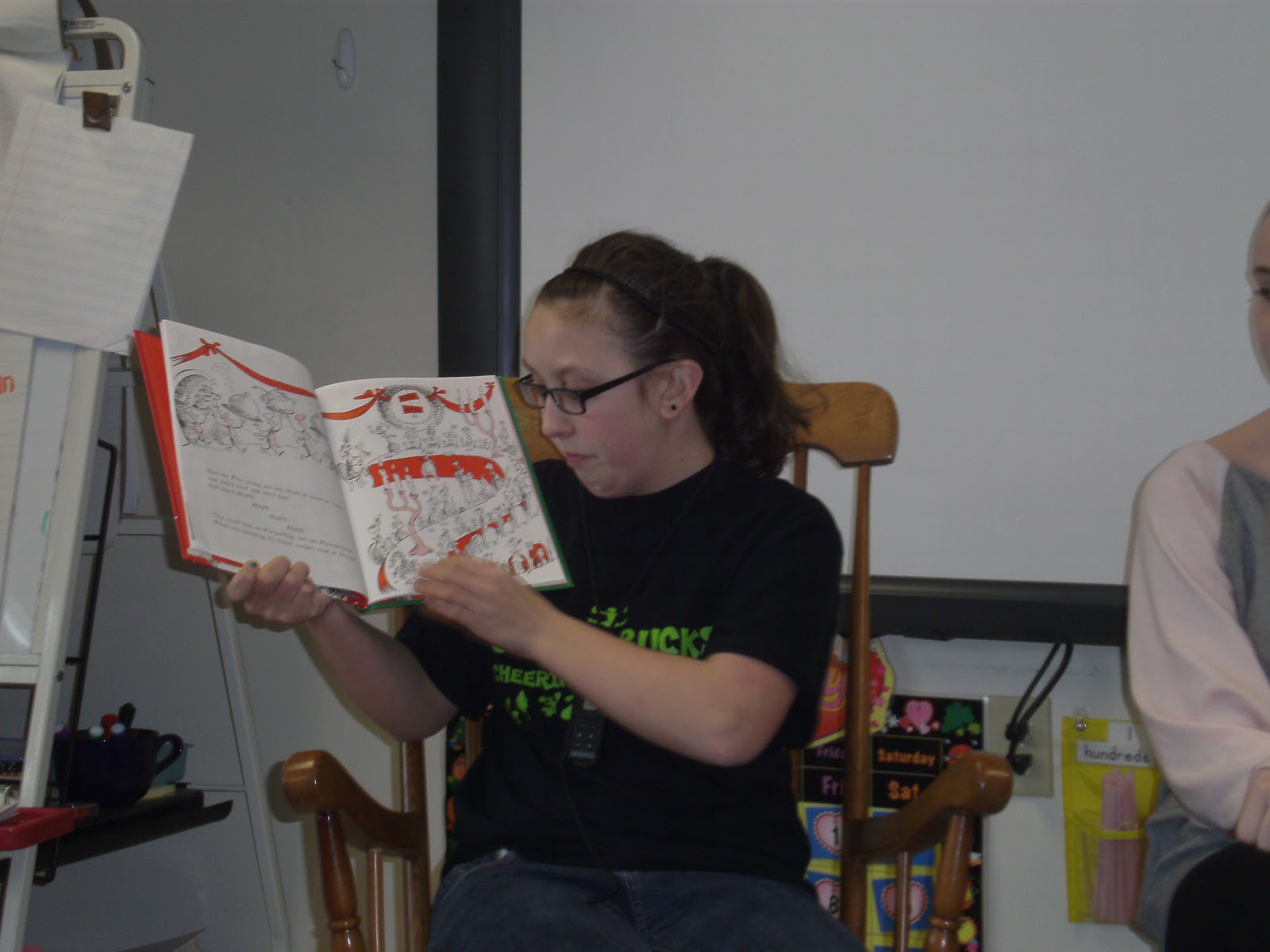
Happy Birthday, Dr. Seuss!

On Friday, March 1 we honored timeless writer Dr. Seuss by inviting a couple of eighth graders in to read to us.  A great big "Thank You" to Jenna Jameson and Kasidy Schaefer!


What we are Learning...

In Reading, we are continuing our theme of "Amazing Animals" - reading about fictional animal characters, as well as learning about the amazing characteristics of real animals.  Students continue to not only develop decoding and other reading strategies, but students are also developing their thinking about reading.  Being a good thinker while reading is what makes a person a good reader.  While reading with your child, include a conversation about connections your child can make between the text (the story being read) and himself, another text, or the world.  Also ask questions that cannot be answered with a simple "yes" or "no"; and may or may not be answered in the story itself.  For example: "How do you think (the character) felt when (something happened)?" or "What would you do if...?"  Another way to encourage thinking about the reading is to ask your child what they think the author meant by (a certain phrase, or figure of speech).  Often times young readers just graze right past odd wording in a story, without giving it much thought.  Challenge your child to be a thinker!

In math, students are still working with tens and ones; and deciding exactly what a story problem is asking and the best way to go about solving it.  We have been focusing a lot on ways to get to 100; such as "If you have 54 marbles, how many more will you need to get to 100?"  Students have been sharing some fabulous strategies around solving problems!

... and the Sea of Talk

I cannot say it enough -- one of the biggest messages that I want all students and parents to know is that it is much more important to go through a process of working through a problem, explaining your thinking, trying it a new way, supporting your thinking ... than to just get a right answer (or to just have a finished product completed).  I can tell that a student is learning by using several methods, such as (but not limited to) observations of independent-  partner-  or small group-  work, working one-on-one with a student, student responses in class discussions, practice worksheets, and of course end of unit and other assessments.  So, for example, when playing a math game is one of the choices on the Math Menu for homework - don't get wrapped up in trying to make things exactly how you think I want you to play.  If you need to (or want to) adapt the game - go right ahead!  Or, while completing the Reading Log, you found that parent and child shared in the reading because the text was particularly challenging - that's perfectly fine!  My message is simple:  I just want our students to be sharing a math experience with another person at home; or experiencing reading in some way.  No strings attached.  This way of thinking holds true in other areas of second grade learning, as well.  The more your child engages with others in discussions around their learning, the more your child will learn!  

One of my favorite quotes comes from educationist James Britton: 
"All learning floats on a sea of talk."

Happy learning, and happy talking!